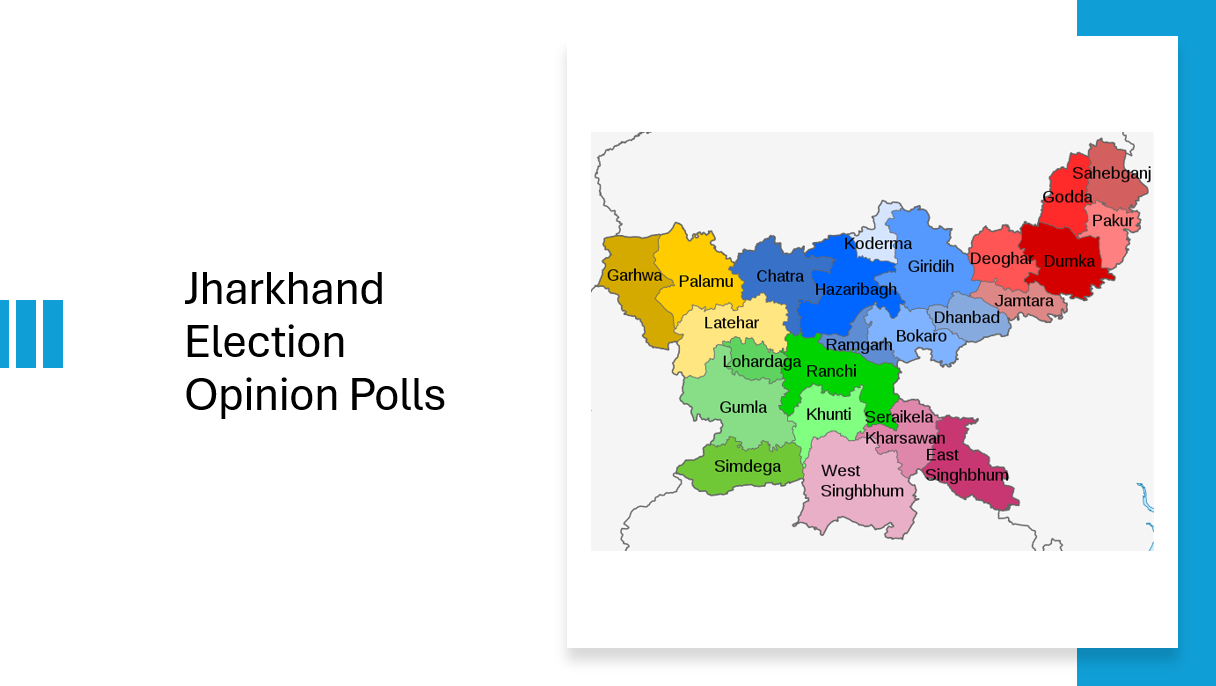
Jharkhand Election Opinion Polls 2024: A close fight between NDA and INDI Alliance is on the card.
- Jharkhand Assembly Elections Polls 2024: BJP: 50-52, INC: 24-26, OTH: 4-6
- Jharkhand Assembly Elections 2024 (Google Trends, 7days): BJP: 63.6%, INC: 18%, JMM: 18%
- Jharkhand Assembly Elections 2024(Google Trends, Leadership): Hemant Soren: 95.3%, Babulal Marandi: 4.6%
The 2024 Jharkhand Legislative Assembly election is scheduled to be held in November–December 2024 to elect all 81 members of the Jharkhand Legislative Assembly. The tenure of the Jharkhand Legislative Assembly is scheduled to end on 5 January 2025. The previous assembly elections were held in November–December 2019.
Currently, the INDI alliance, led by the Jharkhand Mukti Morcha (JMM), is in power in Jharkhand. Hemant Soren once again took the oath as the Chief Minister of Jharkhand on July 4th.
Who Is Ahead in Jharkhand?
- Polls: BJP
- Google Trend (Party): BJP (Higher than 2019)
- Google Trend (Leadership): Hemant Soren
Jharkhand Assembly Election: Major Parties/Alliances
The upcoming Jharkhand Assembly election is expected to be a fight between the two major alliances, the INDI Alliance and the NDA.
INDI Alliance Parties
- Jharkhand Mukti Morcha
- Indian National Congress (INC)
- Rashtriya Janata Dal (RJD)
- Communist Party of India(Marxist-Leninist) (CPI-ML)
National Democratic Alliance (NDA)
- Bharatiya Janata Party (BJP)
- All Jharkhand Student Union (AJSU)
- National Congress Party (NCP)
Jharkhand Assembly Election Insights and Observations
Basic Insights
- Jharkhand’s political landscape is dominated by the BJP, Jharkhand Mukti Morcha (JMM), and Congress, with alliances significantly influencing election outcomes.
- The BJP-led NDA alliance includes the AJSU Party and NCP, while the JMM leads the INDI alliance, which features Congress and RJD.
- Key issues in the election include tribal rights, land acquisition, and development in tribal areas. Corruption could also be a major topic due to Hemant Soren’s arrest and recent return as Chief Minister.
- Infrastructure concerns such as road connectivity, electricity supply, healthcare facilities, and education are critical for rural and semi-urban regions.
- The upcoming Jharkhand assembly election will see a competitive battle primarily between the NDA and the INDI alliance.
Seat-Sharing Plans for Jharkhand Assembly Polls
In the lead-up to the 2024 Jharkhand Assembly elections, the INDIA bloc, consisting of the Congress and the ruling Jharkhand Mukti Morcha (JMM), has announced plans to contest together, aiming to field candidates in 70 of the 81 assembly segments. Chief Minister Hemant Soren confirmed that seat-sharing negotiations are ongoing with alliance partners, including the Rashtriya Janata Dal (RJD) and various leftist parties, for the remaining 11 seats. This collaboration follows the JMM’s success in the 2019 elections, where it won 30 seats, while the Congress secured 16.
Predictions for this election suggest that Congress will likely target 27 to 28 seats, while the JMM aims to increase its representation. Meanwhile, the National Democratic Alliance (NDA), led by the BJP, has revealed a robust seat-sharing formula, contesting 68 seats and partnering with allies like the All Jharkhand Students Union (AJSU) and Janata Dal (United) for the remainder.
Key Political Issues
The ruling Jharkhand Mukti Morcha (JMM) led by Chief Minister Hemant Soren is facing scrutiny over its governance and implementation of promises. The performance of the government in areas like development, corruption, and handling of local issues will significantly impact voter sentiment. Added to it, the internal dispute is hurting his party. Recently, the former CM Champai Soren quit JMM and joined BJP. Following Champai Soren, the ex-JMM MLA Lobin Hembrom also joined BJP.
The opposition, the Bharatiya Janata Party (BJP) is actively working to challenge the incumbent government. The BJP, under its state leadership, is focusing on highlighting the shortcomings of the JMM government and promising better governance and development. In Jharkhand, coalition politics plays a crucial role. The JMM-Congress-RJD alliance has been instrumental in the current government. However, maintaining this alliance and managing conflicting interests will be crucial for the JMM’s strategy. Any friction within this coalition could impact their electoral prospects.
Key issues in Jharkhand include tribal rights, development in rural areas, employment, and infrastructure. Added to the Bangladeshi infiltration is expected to play a key role in the Jharkhand election. Jharkhand ex-CM Champai Soren on joining BJP said that ‘Bangladeshi infiltration a big problem’. Added to it the Jharkhand High Court asked the Jharkhand government to identify the illegal immigrants from Bangladesh.
Overall, the political landscape in Jharkhand is characterized by a mix of governance performance, opposition strategies, internal party dynamics, and regional issues.
Jharkhand Election Opinion Polls 2024

The India Today Mood of the Nation survey indicates that the BJP-led NDA would win 11 out of Jharkhand’s 14 Lok Sabha seats if elections were held today, an improvement from the nine seats won in the previous election.The INDIA bloc is projected to win only three seats, down from five, with one seat going to Congress and two to the JMM, currently in power in the state assembly. The NDA’s expected vote share is 52.1%, while the INDIA bloc’s share is forecasted to decrease slightly to 38.1%.
Observations
- Agricultural GDP Growth: Jharkhand’s agricultural GDP had a Compound Annual Growth Rate (CAGR) of 5.3% between 2013-14 and 2018-19. This growth accelerated to 11% between 2019-20 and 2022-23.
- Rural Unemployment Improvement: Under Chief Minister Hemant Soren, Jharkhand’s rural unemployment rate improved significantly from 33 per thousand in 2018-19 to 9 per thousand in 2022-23. This is compared to the national average, which was 50 per thousand in 2018-19 and 24 per thousand in 2022-23.
- Services GDP Growth Slowdown: Jharkhand’s services GDP experienced a CAGR of approximately 7.51% between 2018-19 and 2022-23, down from the 11.83% growth seen between 2013-14 and 2018-19, indicating a slowdown in this sector.
- Per Capita GDP Rank Decline: Jharkhand’s per capita GDP rank declined from 19th in 2018-19 to 20th in 2022-23, highlighting economic challenges despite other improvements.
- Households Benefitting from Schemes: According to the latest 2024 report, 6.25 million households have benefited from the Jal Yojana, and 1.5 million households from the Pradhan Mantri Awas Yojana (PMAY).
Jharkhand Assembly Elections 2024: A Focus on Tribal Seats
The upcoming Jharkhand Assembly elections in 2024 will significantly depend on the 28 reserved seats for Scheduled Tribes (ST), crucial for achieving the majority mark of 41 in the 81-member assembly. Historically, these seats have been contested primarily by the Jharkhand Mukti Morcha (JMM) and the Bharatiya Janata Party (BJP), with the JMM winning 19 ST seats in the 2019 elections. The BJP, buoyed by previous electoral successes, aims to regain lost ground amid tribal disillusionment that has lingered since 2019. The JMM seeks to leverage this sentiment by emphasizing its ties to tribal identity and issues.
In earlier elections, the competition for ST seats was intense. In 2005, both the JMM and BJP won nine seats each, while the 2009 elections saw the JMM slightly ahead with ten seats. The 2014 elections marked a pivotal moment, with both parties capturing a total of 24 out of 28 ST seats, though the JMM maintained a lead. The 2019 elections revealed a shift, as the JMM capitalized on the BJP’s declining support among tribal voters. As the 2024 elections approach, the JMM’s ability to replicate its 2019 success will be critical for maintaining control. Conversely, the BJP’s strategy appears focused on regaining tribal trust through targeted outreach and by promoting local leaders.
Will Champai Soren’s Induction Help BJP?
Champai Soren’s induction into the BJP ahead of Jharkhand’s Assembly elections could have several significant impacts:
- Soren, known for his deep roots in the tribal communities and his longstanding influence in the Kolhan region, could help BJP improve its standing among tribal voters. His reputation as a strong advocate for tribal rights and his local popularity might boost BJP’s appeal in tribal areas, potentially shifting voter sentiment in favor of the party.
- BJP’s performance in the 2019 Assembly elections in Jharkhand was disappointing, particularly in tribal-dominated areas. With Soren’s addition to the party, BJP aims to make significant gains in these regions, which are crucial due to the large number of reserved seats for Scheduled Tribes. Soren’s presence might help the BJP secure seats in the Kolhan region and other tribal belts.
- Soren’s influence in Kolhan—a region with 14 Assembly seats—could be pivotal. His induction might help BJP in contesting these seats more effectively, potentially leading to a stronger performance in Kolhan, an area where BJP had previously not won a single seat.
- Soren’s focus on issues like tribal identity and land rights, coupled with his criticism of other parties’ handling of these issues, could provide the BJP with a stronger narrative to counter opposition claims. His emphasis on safeguarding tribal interests might resonate well with voters concerned about these issues.
- Soren’s grassroots connections and electoral success as both an Independent and JMM candidate could aid BJP in mobilizing voters more effectively. His network and political experience could translate into more robust grassroots campaigning and voter engagement for the BJP.
- Soren’s shift to BJP might alter the local political dynamics, potentially leading to realignments among other tribal leaders and parties. This change could influence alliances and voter preferences, impacting the overall electoral landscape.
Overall, Champai Soren’s move to BJP is strategically aimed at strengthening the party’s position in tribal regions, addressing past electoral shortcomings, and enhancing its overall appeal in Jharkhand.
Jharkhand Assembly Election Polls 2024
7 days:
- Bhartiya Janata Party: 63.6% (66% in 2019)
- Indian National Congress (INC): 18% (17% in 2019)
- Jharkhand Mukti Morcha: 18% (9% in 2019)
- AJSU: Nil (8% in 2019)
- Jharkhand Vikas Morcha (JVM): Nil in 2019)
Recent Google Trends data highlights a significant shift in political interest in Jharkhand. The Bharatiya Janata Party (BJP) continues to attract substantial attention, reflecting its strong and enduring presence in the state. The Jharkhand Mukti Morcha (JMM) has experienced a notable rise in public interest, further boosting its influence. On the other hand, the Indian National Congress (INC) has seen a decline in public interest, marking a considerable drop compared to previous years. However, data for the Jharkhand Vikas Morcha (JVM), and AJSU Party is not available for direct comparison with past figures.
30 days
- Babulal Marandi: 4.6%
- Hemant Soren: 95.3%
**Regarding leadership, Hemant Soren, the current Chief Minister, commands overwhelming attention compared to his competitor, Babulal Marandi. This significant disparity highlights a clear preference for Soren’s leadership and strong public support for his administration.**
Overview of Jharkhand’s Political Scenario
Jharkhand, a state carved out of Bihar in 2000, has a unique political landscape characterized by its tribal demographics, mineral wealth, and socio-economic challenges. Since its formation, the state has witnessed a dynamic interplay of political forces, shaping its governance and development trajectory. Jharkhand’s political history is rooted in the demand for greater autonomy and recognition of tribal rights. The region’s indigenous tribes, comprising a significant portion of the population, have historically asserted their identity and rights, influencing the state’s political dynamics.
Key Issues
Development: While Jharkhand is rich in natural resources like coal, iron ore, and minerals, disparities in development persist. The state faces challenges in infrastructure, healthcare, education, and employment, particularly in rural and tribal areas.
Tribal Rights and Identity: Issues related to tribal rights, land acquisition, and cultural preservation remain contentious. Political parties often address these concerns to mobilize support among tribal communities, highlighting the complex interplay between identity politics and development issues.
Jharkhand Lok Sabha Election Results
The BJP-led NDA alliance won more seats in Jharkhand than the INDI alliance in the Lok Sabha election. BJP won 8 of 13 contested seats and AJSU won 1. Although the alliance lost three seats compared to 2019, a significant blow came with the defeat of Union Minister Arjun Munda, who lost his Khunti Lok Sabha seat by nearly 1.5 lakh votes.
The INDI alliance won 5 seats, with Congress securing 2 of 7 contested seats and JMM winning 3 of 5. In the Lok Sabha election, the BJP-led alliance had a clear edge, leading in most assembly segments. However, the Lok Sabha results cannot be an indicator for the assembly polls. In Lok Sabha election, the BJP won 12 of the 14 seats in Jharkhand and was leading in 57 of the 81 assembly segments. However, in the assembly election, the BJP dropped to 25 seats, a loss of 12 seats from its 2014 tally. The opposition alliance despite winning just 2 Lok Sabha seats went on to form government.
Jharkhand Last Assembly Election Analysis
In the December 2019 Jharkhand Assembly elections, the Jharkhand Mukti Morcha (JMM), allied with the Indian National Congress (INC) and the Rashtriya Janata Dal (RJD), secured a decisive majority by winning 47 of the 81 seats. The Bharatiya Janata Party (BJP) won 25 seats, the All Jharkhand Students Union (AJSU) won 2, and Babulal Marandi’s Jharkhand Vikas Morcha (P) took 3 seats. JVM(P) has since merged with the BJP, and Marandi now serves as the BJP’s Jharkhand chief.
Reasons for the BJP’s Loss
Despite the BJP’s strong performance in the 2019 Lok Sabha elections, where it won 12 of 14 seats and led in 57 of 81 assembly segments, the party’s assembly results were notably weaker. It fell to 25 seats, a reduction of 12 from its 2014 tally.
The BJP’s loss was driven by an anti-incumbency sentiment against Chief Minister Raghubar Das’s administration, which was criticized for issues like unemployment and agrarian distress. The JMM-led alliance effectively leveraged its support among tribal communities and emphasized regional development.
Internal party discord further contributed to the BJP’s defeat. Chief Minister Raghubar Das’s conflict with MLA Saryu Rai led to Rai running as an independent in Jamshedpur East, where he won by a margin exceeding 15,000 votes.
Demographic and Regional Variations of Jharkhand
Jharkhand, renowned for its rich tribal heritage, displays notable regional diversity influenced by geographical features, socio-economic factors, and historical contexts. The largest tribal community is concentrated in the eastern and northern regions, where they play a pivotal role in the state’s socio-political landscape. Other significant tribal communities such as the Munda, Oraon, and Ho predominantly reside in the central and southern parts of Jharkhand.
Urban-Rural Divide
Jharkhand has a clear urban-rural divide. The majority of the state comes under rural areas. In urban area, Ranchi is the capital and largest city, serving as a political and administrative hub. Jamshedpur and Dhanbad are known as industrial cities with steel, coal, and mineral industries, influencing economic activities and migration patterns.
The majority of Jharkhand’s population resides in rural areas, particularly in tribal-dominated villages and hamlets. Agriculture and traditional livelihoods remain significant in rural economies, with subsistence farming and forest-based activities playing crucial roles.
Voters Demography
As per the latest stats by the Election Commission of India, As per the latest stats by the Election Commission of India, Jharkhand has a total of 2,55,18,642 registered voters. Among them, 1,29,97,325 are male, 1,25,20,910 are female, and 407 identify as third gender. Notably, the state also comprises 8,08,371 voters aged between 18 and 19, with 3,22,709 individuals aged above 80 and 1,39,445 above 85 years old.
Ahead of the Lok Sabha 2024 election, over 3 Lakh new voters registered in Jharkhand

Leave a Reply