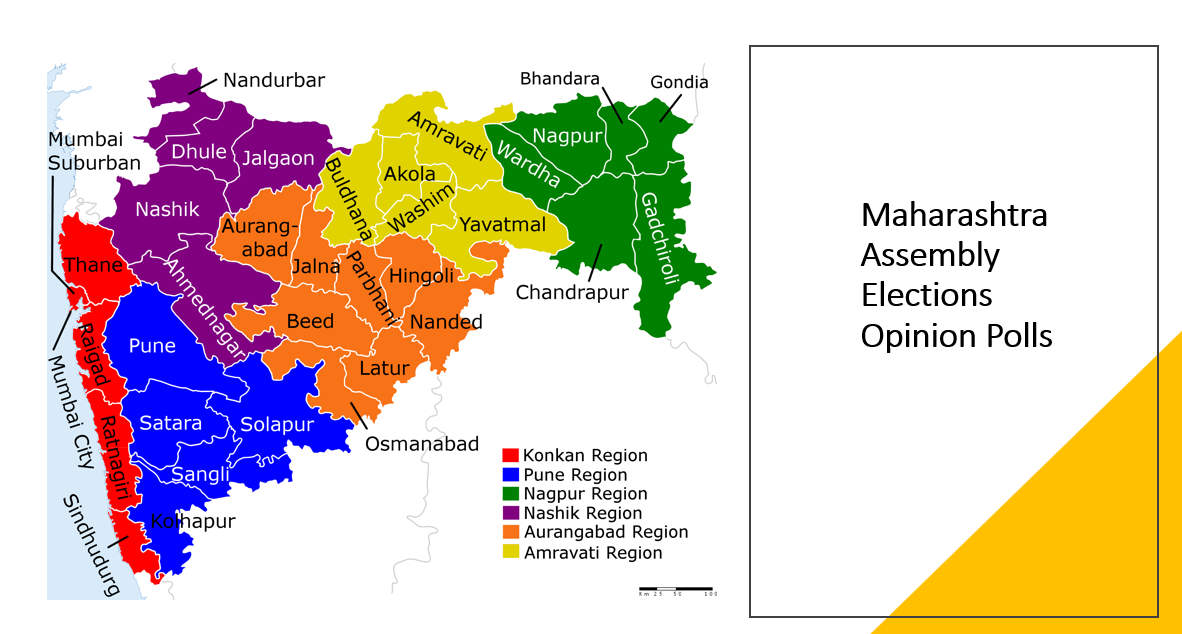
- Maharashtra Assembly Elections Polls 2024
- Opinion Polls: NDA: 132, MVA: 146
- Google Trends, 7days (Partywise): BJP: 75%, INC: 25%
- Google Trends, 7days (Leadership): Uddhav Thackeray: 44%, Eknath Shinde: 56%
Ahead of the upcoming October 2024 Maharashtra state elections, voter sentiment is shaped by ongoing political developments. Eknath Shinde became Chief Minister after Uddhav Thackeray’s 2022 resignation, with Devendra Fadnavis as Deputy CM. The BJP’s trust vote win with 164 votes against MVA’s 99 has solidified its power.
However, the recent Lok Sabha results in Maharashtra did not turn out to be favorable for the BJP-led NDA alliance. The MVA alliance of Congress, Shiv Sena UBT, and NCP(SP) will be highly delighted with the outcome of the Lok Sabha election. With just a few months to go before the election, both alliances have started preparing for the upcoming Maharashtra assembly election.
- Polling Data: Two out of 3 polls have MVA ahead of NDA while the last polls predicted NDA ahead of MVA.
- Partywise Projection, BJP is predicted to emerge as the single largest party. The latest poll has the BJP within the range of 95-105 seats.
- Election Dynamics: The election remains highly polarized, with close races expected between the two coalitions.
Maharashtra Election: Seat Sharing
Mahayuti: The ruling Mahayuti comprising of BJP, Shiv Sena, and NCP are expected to seal the seat distribution. BJP is likely to contest anywhere between 150 and 155 seats, the Sena 90-95 seats, and the NCP 40-45 seats. It is said that the distribution of a majority of seats has been completed. Around 25 seats will need a couple of rounds of discussion.
Maha Vikas Aghadi: Maha Vikas Aghadi is yet to decide on seat sharing. However, as per the news, concensus has been reached on 90% of the seats. Congress wants a larger share of seats in Vidarbha and Marathwada and is ready to cede more seats to the Thackeray-led Shiv Sena (UBT) in Mumbai and Konkan. Congress state president Nana Patole said that the alliance will announce 200 candidates before Dussehra (October 12).
Maharashtra Election 2024: Latest Developments
- Oct 22nd: As the Maharashtra Assembly elections approach, the BJP is intensifying its campaign efforts, featuring Uttar Pradesh Chief Minister Yogi Adityanath in posters across Mumbai with the slogan “Bantenge to Katenge.” Maharashtra BJP president Chandrashekhar Bawankule expressed his appreciation for the support from the party leadership following his nomination from the Kamthi constituency.
Maharashtra Election Observation And Analysis
The latest Lok Poll survey indicates a big surprise in Maharashtra politics. The BJP-led NDA, which won 105 seats in 2019, is projected to secure 115-128 seats with a vote share of 38-41%. However, the opposition Maha Vikas Aghadi (MVA) alliance is forecasted to win 141-154 seats and capture 41-44% of the vote share. This shift is supported by regional trends: MVA is gaining ground in Vidarbha due to agricultural discontent and support from SC/ST voters, while Congress benefits from strong voter bases in Mumbai and West Maharashtra.
The Times Now Matrix opinion poll also predicts a closely contested election in the upcoming Maharashtra Assembly elections. The BJP is expected to be the largest party, winning 95 to 105 seats, followed by the Congress (42 to 47), Shiv Sena (UBT) (26 to 31), and the NCP (23 to 28). Shinde’s Shiv Sena is projected to win 19 to 24 seats, and Ajit Pawar’s NCP wing 7 to 12 seats.

The internal survey conducted by Ajit Pawar’s Nationalist Congress Party (NCP) highlights improving prospects for the Mahayuti alliance ahead of the Maharashtra Assembly elections. The survey indicates that the NCP is confident of winning 23 seats, with another 16 potentially winnable with additional efforts, while vote transfers from its Shiv Sena and BJP allies could secure 21 more seats.
BJP Unveils Candidate List Ahead of Maharashtra Elections
As the 2024 Maharashtra Assembly elections approach, the ruling Mahayuti alliance, led by Chief Minister Eknath Shinde, is close to finalizing its seat-sharing arrangement. A recent meeting attended by Union Home Minister Amit Shah, CM Shinde, and deputy chief ministers Devendra Fadnavis and Ajit Pawar outlined the distribution of seats: the Bharatiya Janata Party (BJP) is expected to contest 156 seats, the Shiv Sena 78 seats, and the Ajit Pawar faction of the Nationalist Congress Party (NCP) is potentially securing 54 seats.
The BJP has already published its first candidate list, which includes 99 names featuring prominent political figures like Fadnavis and Chandrashekhar Bawankule. Additionally, this list highlights candidates with political legacies, including Sreejaya Chavan, daughter of former Chief Minister Ashok Chavan, and Nitesh Rane, son of ex-Union Minister Narayan Rane.
Maharashtra Assembly Elections
- BJP: 75% (2019, day before election: 67%)
- INC: 25% (2019: 33%)
**In the past week, Google Trends data indicates a marked shift in public interest among major political parties. The BJP has witnessed a significant surge in search activity, highlighting an increased focus on its leadership and policies.**
- Uddhav Thackeray: 44%
- Eknath Shinde: 56%
** Recent Google Trends data indicates that Eknath Shinde is leading Uddhav Thackeray by 48.8%, reflecting significantly higher overall public interest in Shinde.**
Which Communities Are Backing Which Alliance in Maharashtra?
As the 2024 Maharashtra Assembly elections approach, caste and community alignments are key factors. The Mahayuti alliance, consisting of the BJP, the Eknath Shinde-led Shiv Sena, and the Ajit Pawar faction of the NCP, enjoys strong support from upper castes, Marathas, and Dalits, as well as economically well-off voters. These groups, along with the Other Backward Classes (OBCs), make up a significant portion of Mahayuti’s base. In contrast, the Maha Vikas Aghadi (MVA) alliance, which includes the Congress, the Uddhav Thackeray-led Shiv Sena, and the Sharad Pawar faction of the NCP, is favored by Muslims, who constitute around 12% of the electorate, as well as Buddhists, neo-Buddhists, and Adivasis. The MVA also holds an advantage among economically disadvantaged voters and farmers, who form a key part of Maharashtra’s rural landscape. Interestingly, the Kunbi community, a crucial demographic, remains evenly divided between the two alliances.
Factors Impacting Upcoming Maharashtra Assembly Election
The upcoming Maharashtra Assembly election is likely to be influenced by several key factors, including socio-economic schemes and issues that are prominent in the state’s political landscape. Here are some of the major elements that could impact the election:
- Maratha Reservation: The issue of Maratha reservation has been a significant point of contention in Maharashtra politics. The demand for reservations in education and government jobs for the Maratha community has been a major political issue. The extent to which the ruling parties have addressed this demand or the opposition’s stance on this matter will likely influence voter sentiment, particularly among the Maratha community.
- Mukhyamantri Ladki Bahin Yojana: This scheme, introduced by the state government, aims to provide financial assistance and support to women from economically disadvantaged backgrounds. Under this scheme, more than one crore women in the state will receive Rs 1,500 per month as direct financial assistance, The effectiveness and reach of this scheme, as well as its impact on women’s empowerment and social welfare, will be crucial factors in shaping voter opinions, especially among women voters.
- Ladla Bhai Yojana: Maharashtra Chief Minister announced the launch of the ‘Ladla Bhai Yojana’, also known as ‘Maza Ladka Bhau Yojana’, which provides financial assistance for the youth of the state who have passed 12th grade or diploma courses or are graduates. The Ladla Bhai Yojana Maharashtra also provides a stipend to the youth, thus promoting skill development too. the government has stated that eligible youths who have passed their 12th grade, diploma, and graduation will receive Rs.6,000, Rs.8,000, and Rs.10,000 every month.
- Infrastructure Development: The state’s infrastructure projects, including improvements in transportation, healthcare, and education, are critical. The performance and promises of the ruling party in these areas can sway voters who prioritize development and efficient public services.
- Economic Performance and Job Creation: Economic conditions, including employment rates and economic growth, play a crucial role in elections. The ruling party’s track record on economic management and job creation will be closely scrutinized by voters.
- Agricultural Issues: Maharashtra’s significant agricultural sector means that issues like farmer distress, crop prices, and rural development are central. The effectiveness of government schemes aimed at supporting farmers and rural areas will be a key factor in the election.
- Local and Regional Issues: Localized issues, such as regional development, urban planning, and specific community concerns, will also impact voter preferences. The performance of local leaders and the responsiveness of the government to regional demands can influence election outcomes.
- Party Alliances and Candidate Selection: The dynamics of party alliances, such as the Mahayuti Alliance and the Maha Vikas Aghadi (MVA), and the popularity and effectiveness of the candidates they field, will be crucial. Voter perception of party alliances and individual candidates’ ability to address local issues will play a significant role.
- Unified Pension Scheme (UPS): Maharashtra has introduced the UPS, guaranteeing a minimum pension of Rs 10,000 per month after 10 years of service and 50% of the average salary for the last 12 months after 25 years. This scheme, along with provisions for family pensions and inflation adjustments, represents a shift from the Old Pension Scheme (OPS) and National Pension System (NPS). It may set a precedent influencing other states and will be a significant factor in the election.
Economic Analysis of Maharashtra
Maharashtra stands out as one of India’s most prosperous states and plays a pivotal role in the nation’s economic development. With a nominal Gross State Domestic Product (GSDP) of approximately USD 435 billion for the fiscal year 2022-23, Maharashtra boasts the largest economy among Indian states. It contributes 12.92% to India’s GDP and has a per capita income that surpasses the national average. The state’s GDP in 2012-13 was around USD 235 billion, reflecting an average annual growth rate of 9.4% over the past decade.
However, in terms of ranking for per capita income, Maharashtra dropped from fifth last year to sixth, behind Telangana, Karnataka, Haryana, Tamil Nadu, and Gujarat. The state’s per capita income is expected to grow to ₹2,77,603 in 2023-24 from ₹2,52,389 crore in 2022-23.
Maharashtra excels in manufacturing, holding a 13.8% share of India’s industrial output. It is also a major player in foreign direct investment (FDI), accounting for approximately 29% of the nation’s total FDI. Additionally, the state contributes significantly to the MSME sector, representing about 8% of the total MSMEs and providing around 8% of employment within this sector across India.
Lok Sabha 2024 Results
The Lok Sabha 2024 election was a direct fight between the NDA and INDI alliance. In 2019, the BJP-led NDA alliance won 40 seats while the opposition alliance managed to win only 8 seats. However, in 2024, the BJP-led NDA managed to win only 17 seats, down 23 seats from its 2019 tally. BJP won 9 seats while Shiv Sena won 7 seats. NCP managed to win only 1 seat.
In contrast, opposition parties excelled: Congress won 13/15 contested seats, NCP(SP) won 7/10 and Shiv Sena won 9/21 contested seats. 1 seat was won by the independent candidate. As state elections approach, this discontent may lead to a fragmented vote, challenging the BJP’s dominance. In terms of assembly lead, the BJP-led NDA was leading in 127 constituencies while the INDI alliance was ahead of NDA in 149 assembly segments.
In agriculture, Maharashtra is a leading producer of gram, arhar (pigeon pea), and soybeans. It ranks second in the production of pulses, and sugarcane, and third in cotton and nutri/coarse cereals.
Maharashtra Assembly: 2019 Election Summary
The last Maharashtra Assembly election was held in 2019 and the election was the fight between the two alliances, NDA and UPA. The NDA alliance then had BJP and Shiv Sena led by Uddhav Thackeray. While the UPA alliance had Congress, NCP, and other smaller parties.
The results came in favor of the NDA alliance with BJP winning 105 seats and Shiv Sena winning 56 seats. Congress on the other hand won 44 seats while NCP won 54 seats. However, after the result, Shiv Sena left NDA and formed a government with the help of Congress and NCP.
Maharashtra Assembly Elections: Demography
Maharashtra’s population is projected to be 12.77 crores. In 2024, the sex ratio of the total population in Maharashtra will be 108.4 males per 100 females. There are 6.64 crore, males and 6.12 crore, females, in Maharashtra. Maharashtra has 5,112,000, more males than females. Maharashtra accounts for 9.09 percent of the Indian population.

Leave a Reply