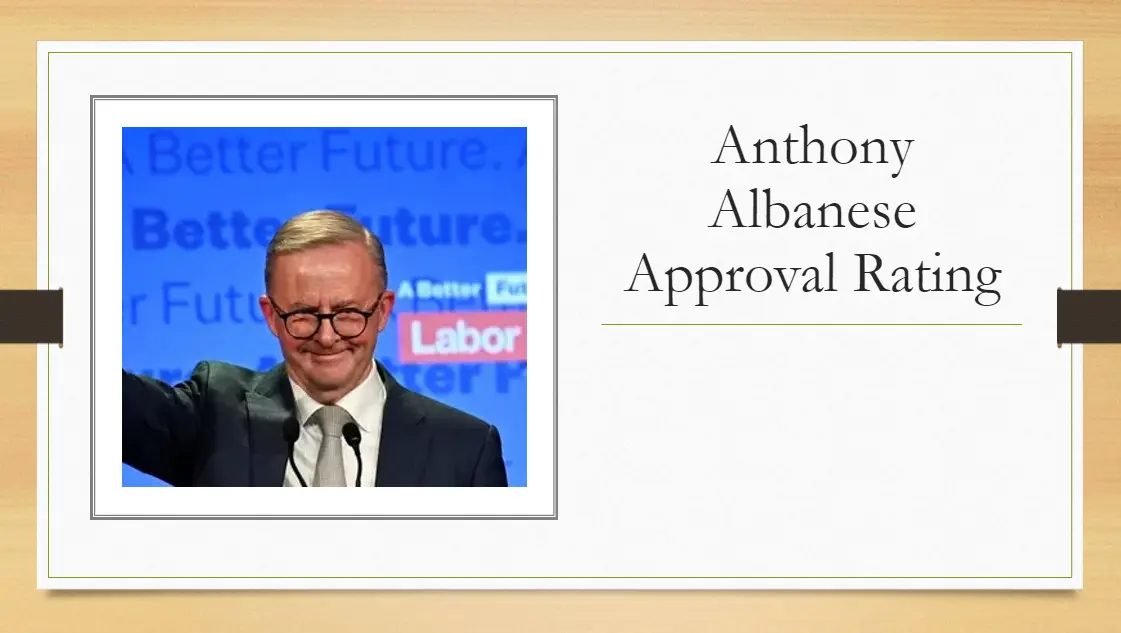
Anthony Albanese’s approval rating in 2024 has fallen, influenced by the country’s cost of living, economic performance, and handling of key issues.

In the dynamic landscape of Australian politics, public opinion plays a crucial role in shaping the trajectory of leaders and their policies. Anthony Albanese, the current Prime Minister of Australia faces ongoing scrutiny and evaluation through his approval ratings. This article delves into the factors influencing Albanese’s approval rating, its implications for his leadership, and the broader political implications for Australia.
Factors Influencing Anthony Albanese’s Approval Rating
- Anthony Albanese’s approval rating has fallen, influenced by factors such as the country’s economic performance, policies, and handling of key issues.
- According to a Guardian Essential Poll, 75% of respondents believe the government is not adequately addressing the cost of living, while 20% think it’s doing enough and 5% think it’s doing too much.
- Similarly, 68% feel the government isn’t doing enough for affordable and secure rentals, with 25% believing it’s doing enough and 6% thinking it’s doing too much.
- However, more voters believe the government is doing enough on renewable energy (43-41%) and electric vehicles (47-34%).
- On environmental issues, a slim majority supports more government action: 51-42% for preserving endangered species, oceans and rivers, and native forests; 49-43% for mitigating climate change effects; and 45-39% for restricting offshore oil and gas development.
Anthony Albanese Approval Rating Polls

**The net approval rating for Prime Minister Anthony Albanese is currently -12.0%. This negative rating highlights growing dissatisfaction with his leadership and underscores the challenges facing the Labor government in maintaining voter support.**
Albanese’s Leadership: A Test for Labor
Anthony Albanese’s leadership is facing increasing criticism as Labor struggles to maintain its power ahead of the next federal election. In the ACT election, Labor is expected to lose seats, with ACT leader Andrew Barr potentially needing support from independents to remain in power. The Greens, part of his coalition, have positioned themselves as a more progressive alternative, criticizing Labor’s stagnation.
Meanwhile, Labor’s anticipated defeat in Queensland is largely attributed to federal issues, including dissatisfaction with the government’s handling of the cost of living, AUKUS, environmental policies, and its perceived lack of progressive action. A poor result in Queensland could galvanize internal dissent within the federal Labor party, especially among backbenchers concerned about their seats. Amid these challenges, Albanese’s policies on housing, childcare, and healthcare remain vague to the public, raising doubts about Labor’s ability to effectively address these concerns.
Anthony Albanese vs Peter Dutton: Google Search Trends

**Over the past seven days, Google Trends data reveals that Anthony Albanese’s search volume significantly surpasses Peter Dutton’s. **
Preferred Prime Minister Polls: Anthony Albanese vs Peter Dutton

Most Australians prefer Anthony Albanese as their Prime Minister, with an approval rating of 42%. In contrast, Peter Dutton holds a 38% approval rating, indicating a slight lead for Albanese. This preference reflects ongoing public support for Albanese compared to his main opponent.
Latest Federal Election Polls 2024: Vote Shares
!function(){“use strict”;window.addEventListener(“message”,(function(a){if(void 0!==a.data[“datawrapper-height”]){var e=document.querySelectorAll(“iframe”);for(var t in a.data[“datawrapper-height”])for(var r=0;r<e.length;r++)if(e[r].contentWindow===a.source){var i=a.data["datawrapper-height"][t]+"px";e[r].style.height=i}}}))}();The last five polls conducted on october 6 indicate that the Liberal Party is maintaining its lead over the Australian Labor Party and the Green Party. The average of the last three polls shows the Liberal Party with a lead of 36.5%, the Australian Labor Party with 31.1%, and the Green Party with 12%.
Australia Federal Election News 2024: Observations
- Oct 22nd: The Coalition is strategically opposing Labor’s housing policies by emphasizing the demand for detached homes in outer suburbs, believing that voters prefer traditional housing over high-density developments and state-built public housing. The Coalition plans to unlock approximately 500,000 homes through targeted funding to councils, with an average cost of $10,000 per initiative. In contrast, Labor’s Housing Affordability Fund aims to provide 30,000 dwellings at an average cost of $300,000 each.
Accuracy of Pollsters in the Federal Election 2022
Resolve Strategic and Newspoll were the top 3 pollsters in the 2022 election and both polls show ALP ahead now.
| Pollster | L/NP Error | ALP Error | GRN Error | Total Error |
|---|---|---|---|---|
| Resolve Strategic | Under by 1.3 | Over by 1.3 | Over by 1.3 | 3.9 |
| Roy Morgan | Under by 1.7 | Over by 1.4 | Over by 0.8 | 3.9 |
| Newspoll-YouGov | Under by 0.7 | Over by 3.4 | Under by 0.2 | 4.3 |
| Ipsos | Under by 0.7 | Over by 3.4 | Over by 0.8 | 4.9 |
| Essential | Over by 0.3 | Over by 2.4 | Under by 3.2 | 5.9 |
Anthony Albanese Approval Rating: Promises made in the 2022 election
This is a brief list
- Healthcare
- 50 Medicare Urgent Care Clinics
- Change the rules to allow regional and outer metro communities to recruit more doctors of their choosing – both locals and overseas-trained GPs.
- Increasing the number of screened conditions for newborns from around 25 to 80.
- Establishing an Australian Centre for Disease Control.
- Reducing the Pharmaceutical Benefits Scheme (PBS) co-payment from the current maximum of $42.50 per script to a maximum of $30 per script. Savings of $12.50
- Education
- Fee Free TAFE
- $1.2 billion Future Made in Australia Skills Plan to close the gap in key areas of skills shortages with new places at university and TAFE. Made in Australia Skills Plan will also deliver up to 20,000 new university places.
- $50 million TAFE Technology Fund will improve IT facilities, workshops, laboratories, and telehealth simulators across the country.
- $100 million New Energy Apprenticeships will encourage and support 10,000 apprentices to train in new energy jobs.
- Childcare
- Labor will invest approximately $5.4 billion to make child care cheaper, starting from July 2023.
- Increase child care subsidy rates for every family with one child in care earning less than $530,000 in household income
- Lift the maximum childcare subsidy rate to 90 percent for families with the first child in care. Keep higher childcare subsidy rates for the second and additional children in care
- Extend the increased subsidy to outside school hours care.
- Manufacturing
- $15 billion National Reconstruction Fund
- Up to $3 billion from Labor’s National Reconstruction Fund to invest in green metals.
- $1.5 billion Medical Manufacturing Fund, building on Labor’s Buy Australian Plan
- $1 billion Value Adding in Resources Fund.
- $1 billion in investment support through loans, equity, and guarantees for businesses in critical technologies.
- $1 billion in advanced manufacturing creating new capabilities and opportunities to innovate in transport, defense, resources, agricultural and food processing, medical science, renewables, and low-emission technologies manufacturing.
- $500m of funding within our National Reconstruction Fund for Agriculture, Forestry, Fisheries, Food, and Fiber.
- Labor’s Renewables Plan
Anthony Albanese Approval Rating: Promises Implemented so far
1) National Anti-Corruption Commission Bill 2022
As promised, the Albanese Government has delivered on its commitment to establish a National Anti-Corruption Commission (NACC). The bill passed both the Australian House of Representatives and the Senate by November 29, 2022, and is expected to be finalized by mid-2023. The commission will have independent powers to investigate corruption in the Commonwealth public sector, including ministers, parliamentarians, and government employees. It will also provide protection for whistleblowers.
2) Energy Price Relief Plan
The bill is expected to help ease the skyrocketing energy prices such that bills will rise by 13% rather than the expected 36% in 2023-24.
The legislation plans to:
- Impose a Temporary cap on the price of gas for 12 months at $12 per gigajoule on new wholesale gas sales by east coast producers subject to consultation.
- Temporary cap on the price of coal: The NSW and Queensland Governments are setting ceilings for the price of coal used for electricity generation to $125 a tonne.
- Provide Targeted Bill Assistance: The Government will partner with the states and territories to deliver targeted and temporary relief on power bills to eligible Australian households and small businesses. An Energy Bill Relief Fund with up to $1.5 billion will be established to deliver relief directly to electricity bills
- Investment in Cleaner, Cheaper, Reliable Energy for the Future: Around $10 billion will be invested under the scheme in private and public sector investment to ensure long-term affordability and accessibility of clean and cheap energy.
3) Fairwork Legislation Act 2022
The Fair Work Legislation Amendment (Secure Jobs, Better Pay) Bill 2022 aims to make numerous changes to industrial relations legislation.
- Promote flexible working arrangements (FWAs).
- Promote gender equity and strengthen the legal framework in respect of sexual harassment and anti-discrimination protections.
- Promote wage growth through bargaining, approval, and termination processes.
- Improve job security by prohibiting certain fixed-term contracts
- Abolishes the Australian Building and Construction Commission (ABCC) and establish The National Construction Industry Forum which will provide advice to the government on the building and construction industry.
4) Ozone Protection Act
The Ozone Protection and Synthetic Greenhouse Gas Management Reform (Closing the Hole in the Ozone Layer) Bill 2022 updates Australia’s laws to manage ozone-depleting substances and synthetic greenhouse gases. These substances, commonly used in refrigerators, air conditioners, fire extinguishers, and aerosols, are regulated and phased out under Australia’s commitment to the 1989-ratified Montreal Protocol.
The Australian Government is collaborating with industries to reduce the use of hydrofluorocarbons (HFCs) by 85% from 2018 to 2036. The Bill aims to enhance the efficiency of the management program.
2022 Australian Federal Election Results
The 2022 Australian federal election was held on Saturday 21 May 2022 to elect members of the 47th Parliament of Australia. The Labor Party, led by PM Anthony Albanese defeated the incumbent Liberal/National Coalition government led by Prime Minister Scott Morrison who was contesting for a fourth consecutive office term. Winning 77 seats in the House of Representatives, the Australian Labor Party achieved a majority government for the first time since 2007. Anthony Albanese was sworn in as Prime Minister on 23 May 2022.

Leave a Reply